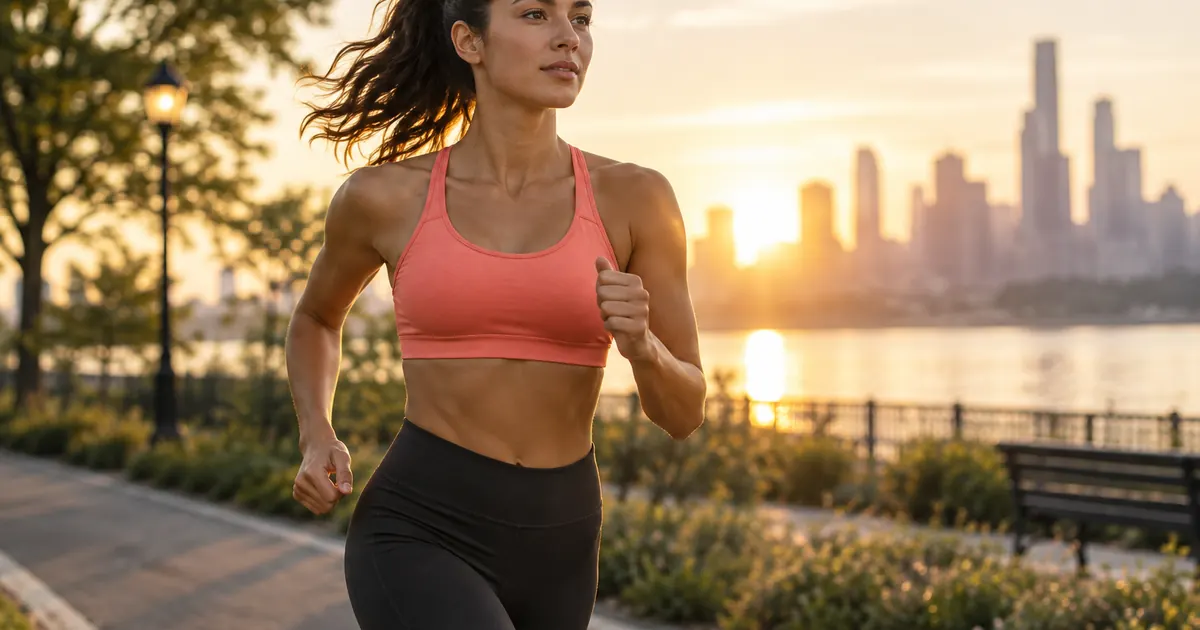
Sports bra packaging loves the words "supportive" and "comfortable," but neither tells you what happens at mile three of a run. What matters is impact level — how much the bra is engineered to control movement — and matching that to what your workouts actually demand. Get it right and you forget you are wearing it. Get it wrong and no amount of padding fixes it.
What "impact" actually measures
Impact rating describes how much breast tissue movement the construction is designed to control. During running, tissue can move several centimeters in multiple directions — up-down, side-to-side and in a figure-eight pattern. A bra built for yoga controls almost none of that; a high-impact running bra controls all of it through band tension, cup encapsulation and strap geometry.
Low impact: yoga, Pilates, walking, lifting light
Low-impact bras prioritize stretch and comfort over lockdown. Look for soft, wide bands, minimal hardware and knits that move with you. The PulseKnit Cloud Low-Impact Yoga Bra is built exactly for this — a seamless knit that stretches through inversions and never digs during long holds. If your training is mat-based, walking or mobility work, this is your category. Wearing more bra than you need just adds heat and pressure.
Medium impact: strength training, cycling, spin, rowing
Medium-impact work involves bounce in short bursts, but not the sustained vertical pounding of running. You need a firmer band and more structured cups, but not full encapsulation. The SheFit Breeze Medium-Impact Bra sits here: enough structure for kettlebell swings and spin class, enough stretch for overhead presses. A good medium-impact bra should pass the "raise your arms" test — the band should not ride up when you lift overhead.
High impact: running, HIIT, jumping, court sports
This is where construction differences get dramatic. High-impact bras combine three things:
- Compression plus encapsulation: pressing tissue against the body while also holding each side separately controls movement in every direction.
- Wide, anchored underbands: the band does most of the work. It should sit level all the way around and not stretch out when pulled.
- Reduced strap elasticity: some vertical give is fine; horizontal stretch is what lets bounce through.
The SheFit Elevate High-Impact and AeroFlex Power High-Impact are both built on this formula — the Elevate with a longline silhouette for extra torso anchoring, the Power with molded cups for shape definition under thin tees.
Fit rules that apply at every impact level
The band is the foundation
Eighty percent of support comes from the band, not the straps. It should feel snug on the loosest hook — firm enough that you can fit two fingers under it, no more. If the band rides up when you raise your arms, go down a band size.
Straps carry a little, not a lot
If your shoulders carry the day, the band is too loose. Racerback styles like the SheFit Stride Racerback pull the straps inward, which improves posture and keeps them from sliding during overhead work.
Cups should hold, not squash
Tissue should be fully inside the cup with no spillage at the top or sides. Molded cups keep their shape under layers; seamless knits disappear under everything.
One quick decision table
- Yoga, Pilates, walking → low impact
- Lifting, spin, circuits → medium impact
- Running, HIIT, jumping → high impact
- Doing two of these in one session? Dress for the highest-impact one.
Fabric and features that change the equation
Beyond impact level, three construction details decide how a bra actually feels in session. Molded cups hold their shape under thin layers and prevent the "uni-boob" effect of pure compression knits. Seamless knits disappear under everything and dry fastest, which makes them ideal for hot studios. And longline silhouettes — like the AeroFlex Sculpt Longline — add a band of ribbed support around the torso that effectively anchors the bra to your core instead of your ribs alone.
Adjustability matters less than people expect at these price points. A well-cut band on the loosest hook outperforms an adjustable strap system on a badly cut bra. Prioritize cut first, features second.
How many sports bras do you actually need?
One per workout day between laundry cycles, minimum. Training four days a week means at least two bras in rotation — three is the practical sweet spot, because elastane needs about 24 hours to recover its shape after a wash. Rotating three bras, each lasts years; rotating one, it dies in months. That math, more than any brand difference, is why some bras seem to "wear out fast."
Browse the full sports bra collection — every style lists its impact level on the product page, and every order ships free with 30-day returns.
Train in gear that passes the tests
Every Shefit piece is squat-tested, wash-tested and wear-tested before it ships. Free US shipping, tax free, 30-day returns.
Shop Bestsellers