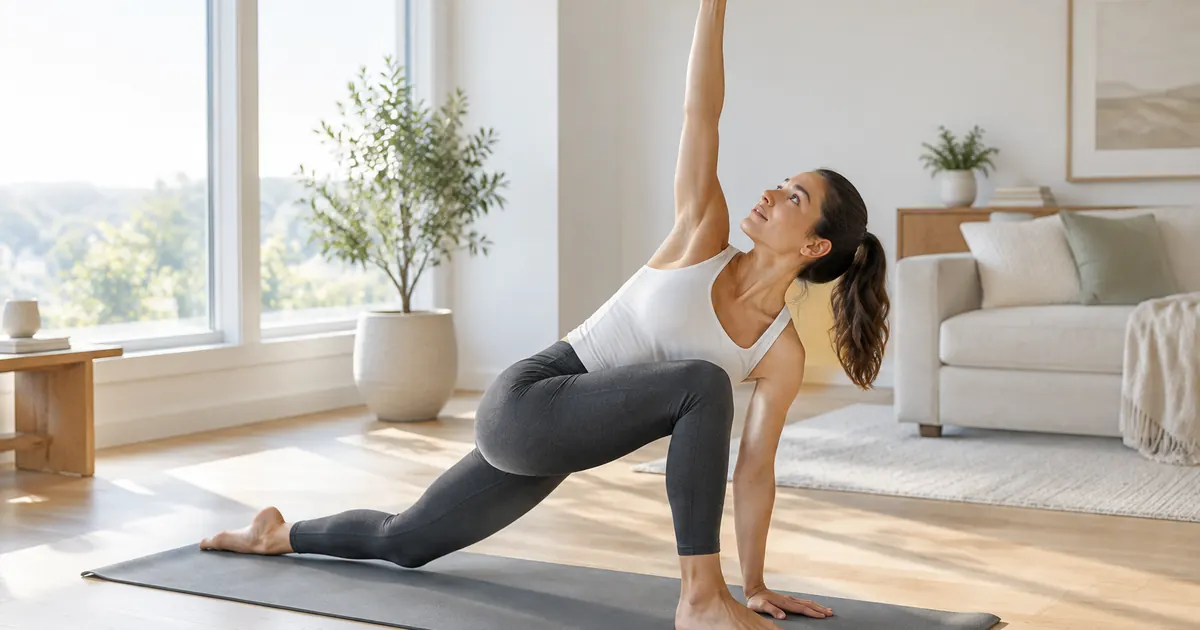
If your first three exercises always feel heavier and tighter than they should, the problem is not fitness — it is temperature. Overnight, joint fluid thickens and connective tissue literally stiffens. Morning training is fine; walking into it cold is not. This five-minute sequence fixes the stiffness without cutting into your training time.
Why five minutes is enough
A warm-up has two jobs: raise tissue temperature and take your joints through the ranges you are about to load. It does not need to be long — it needs to be specific. Research on warm-up duration consistently shows that five to ten minutes of progressive dynamic movement produces most of the performance benefit; beyond that, you are mostly just spending energy. The routine below covers hips, spine, shoulders and ankles — the four areas that carry almost every workout.
Minutes 0–1: breathe and hinge
Start standing. Take five slow breaths with long exhales — this drops your heart rate baseline and switches you out of "just woke up" mode. Then perform ten hip hinges: push your hips back, soft knees, hands sliding down your thighs, stand tall. This wakes up the posterior chain and rehearses the exact pattern squats and deadlifts use.
Minutes 1–2: world's greatest stretch
Step into a deep lunge, place both hands inside the front foot, drop the back knee, then rotate the arm on the same side as the front leg up toward the ceiling. Hold two seconds, return, alternate sides. Five per side. This single move opens the hips, thoracic spine and shoulders at once — it is the highest-value stretch in existence for people who sit at desks.
Minutes 2–3: leg swings and ankle rocks
Hold a wall or rack. Swing one leg forward and back ten times, then side to side ten times. Switch legs. Then do ten ankle rocks per foot — heel up, heel down, knee tracking over the toes. Ankle mobility is the hidden limit on squat depth for most lifters, and it responds to motion faster than to static stretching.
Minutes 3–4: arm circles and band pull-aparts
Ten big arm circles forward, ten backward. If you have a resistance band, add fifteen pull-aparts; if not, do fifteen reverse snow angels on the floor. This primes the rotator cuff and scapular muscles before any pressing or pulling. Training in a tank like the SheFit Airflow Racerback helps here too — full shoulder visibility means you can actually see your form.
Minutes 4–5: ramp your first exercise
Spend the last minute rehearsing your first movement at low intensity: bodyweight squats before barbell squats, push-ups before bench, an easy 30-second stride before a run. Two or three ramp sets of your first exercise finish the job — by set one of your real workout, you are at full output.
Dress for the first five minutes
Morning sessions start cold, and staying cold defeats the warm-up. A light layer you can shed as you heat up makes the sequence far more effective. The PulseKnit Everyday Crew over a training top is our team's default for 6 a.m. sessions; on colder mornings, the CloudSoft Fleece Hoodie adds warmth without bulk. Shed it after minute three and you will hit your first working set already warm.
What NOT to do
- Do not static-stretch cold muscles for long holds — save 60-second holds for after training.
- Do not skip the warm-up because the workout is short. Short sessions need proportionally longer warm-ups.
- Do not warm up on the machine you are about to max out on. Move through ranges first, load second.
Adapt the sequence to your session
The five minutes above are the base template. On lower-body days, add thirty seconds of bodyweight squats and glute bridges before the ramp sets. On upper-body days, extend the arm circles to fifteen per direction and add ten push-ups. On running days, finish with two 20-second strides at increasing speed. The skeleton stays the same; you are just biasing the last minute toward the muscles about to work.
If you are over 40 or returning from a break
Extend the sequence to eight minutes rather than changing it. Add a second round of the world's greatest stretch and give the ankle rocks thirty extra seconds per foot. Tissue that has been sedentary — or recovering — responds to longer, gentler ramping, not to more aggressive stretching. The sequence stays identical; the durations stretch.
Track it like training
The warm-up is the cheapest performance upgrade in fitness, and it is measurable. Note your first-set output on your main lift for two weeks with the full warm-up, then two weeks without. Most people see their first working set feel a full RPE point easier with the routine — which is exactly the point. Five minutes buys you a better hour.
Five minutes, every session, no exceptions — that habit is worth more than any supplement. Need gear that keeps up? The tops collection and shorts collection are built for exactly this kind of work.
Train in gear that passes the tests
Every Shefit piece is squat-tested, wash-tested and wear-tested before it ships. Free US shipping, tax free, 30-day returns.
Shop Bestsellers